
Your Ultimate Guide To SEO For Wedding Photographers

Did you know that over 104,500 wedding photography-related searches are happening in the UK every single month? That number jumps to 176,000 in the US! Every one of those searches is a couple looking for their wedding photographer. And if your website isn’t showing up, someone else is getting that enquiry.
I’m Nergis, an SEO consultant specialising in wedding businesses. I’ve worked with wedding photographers all over the world to help them get found by the right couples on search, and this guide is the most comprehensive resource I’ve put together on wedding photography SEO.
Whether you’re just starting with SEO or you’ve tried a few things and aren’t sure if they are working, this guide will walk you through everything you need to know step-by-step. Grab a cuppa, bookmark this page, and let’s get into it.
Why SEO Is So Important for Wedding Photographers?
Before we get into the how, let’s talk about the why - because understanding this will completely change how you think about your website and overall marketing.
Wedding photography is one of the most searched-for services in the wedding industry. And here’s something most photographers don’t realise: search isn’t just happening on Google. Couples are searching on Pinterest for inspiration and discovering photographers whose work comes up in those results. They’re searching on Instagram using keywords and location tags. They’re using all of these platforms to find and shortlist suppliers, and if you’re not showing up, someone else is getting that enquiry.
If you’re visible across all three platforms during that discovery phase, you have a huge advantage.
And here’s what makes SEO different from every other form of marketing: it keeps working for you around the clock, without you having to do anything. A well-optimised page on your website, a pinned optimised post on Pinterest, or a searchable Instagram caption paired with an optimised bio can bring in enquiries while you’re shooting a wedding, on holiday, or fast asleep. You do the work once, and it pays off over and over again.
Beyond that, couples who find you through search - whether that’s Google, Pinterest, ChatGPT or Instagram - are often further along in their decision-making. They’ve searched for something specific, which means they already know what they want. They’re actively looking for you, with the intent to eventually book.
That’s the power of SEO. And that’s why investing in it is one of the best things you can do for the long-term growth of your wedding photography business.
How To Build an Effective SEO Strategy for Your Wedding Photography Business?
SEO can feel overwhelming when you first dive in, so I’ve broken it down into ten clear steps, covering your website, Google Business Profile, Pinterest and Instagram.
You don’t need to do everything at once. Work through each step one at a time, and remember that every small improvement adds up.
Step 1: Discover Your Most Important Keywords
Before you can show up in search results, you need to know what your ideal couples are actually typing into Google. This process is called keyword research, and it’s the foundation everything else is built on.
Start by brainstorming a list of words and phrases that describe your business - your style, your services, and the locations you work in. Think like a couple planning their wedding, not like a photographer. What would you search for if you were looking to hire someone like you?
Once you have your initial list, use free keyword research tools like Ahrefs Keyword Generator or Ubersuggest to explore search volumes and see what else couples are searching for. For my clients, I typically recommend focusing on keywords with a minimum search volume of 20 and a maximum keyword difficulty of 40 - these give you the best chance of ranking, especially if you’re quite new to the scene.
Must-have keywords for wedding photographers:
Here are some essential keyword variations that you need as a wedding photographer.
Wedding photographer + [your city/country/region]
[City/country/region] + wedding photographer
[Your style] + wedding photographer
[Your style] + wedding photography
Wedding photographer + [specific venue name]
Always align your keyword strategy with your business goals for the next six to twelve months. If you want to book more elopements, focus on elopement keywords. If you’re targeting destination wedding couples, focus on destination wedding photographer keywords. Your SEO should be working towards the business you want, not just the business you have.
Pro tip: Keep in mind that these same keywords will feed into your Pinterest and Instagram strategy too, so getting clear on them makes everything else easier.
Step 2: Create Dedicated Landing Pages For Your Keywords
Once you know what you want to rank for, you need to make sure you have dedicated pages on your website that target those keywords. Not one page trying to cover everything - specific pages for specific keywords.
Landing pages are like little powerhouses with a clear mission. If you offer destination wedding photography in Italy, wedding photography in Devon and elopements in the Scottish Highlands, each of these deserves its own page. Each page has one clear focus, one target keyword, and one purpose: to show up for that specific search and convert the right couple into an enquiry.
Each landing page should include a clear call to action, whether that’s a contact form, a link to your booking page, or an invitation to explore your portfolio. Make it easy for couples to take the next step once they land on your page.
Pro tip: Before creating new pages, give your homepage some love first. Your homepage is the most powerful page on your website, and it should be optimised for your primary business keyword - something like ‘Wedding Photographer + [Your Main City]’. Start there and build outwards.
Step 3: Use Your Keywords Strategically
Once you have your pages, you need to tell Google and AI platforms what each one is about. There are five key places to include your keywords for an effective wedding photography SEO:
Meta title: This is the clickable page title that appears on Google Search Results. Make it unique, compelling, and include your target keyword.
Meta description: The short description below the title in search results. Write it like a mini ad for your page - include your keyword and give people a reason to click.
Page heading (H1): The main title on the page itself. Make sure to include your keyword naturally.
Page body: Aim to include your keyword in the first paragraph. This helps search engines understand the focus of your page right from the start.
Website footer: Add a brief business description to your footer that includes your main keyword. It's a subtle but effective signal to Google about what your business does.
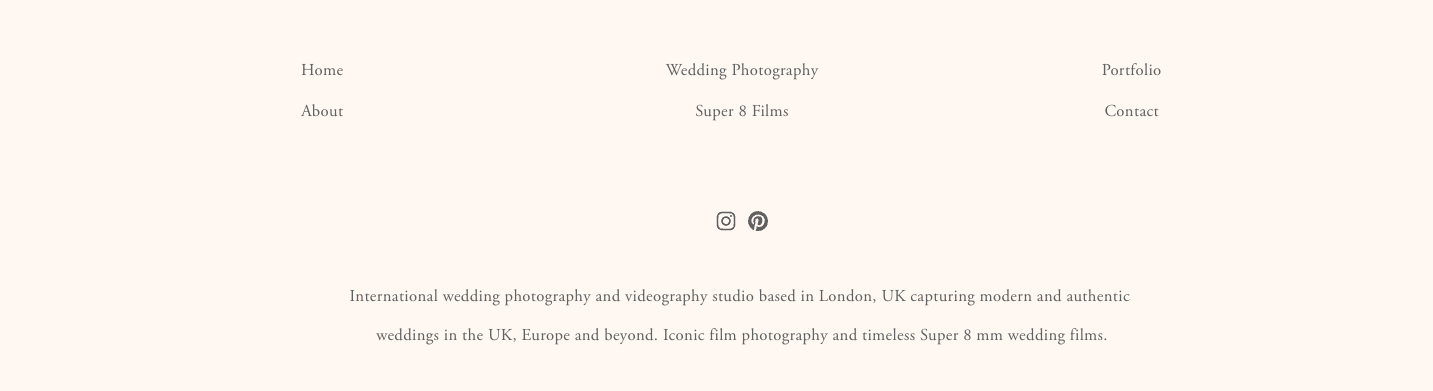
Website footer example from one of my wedding photographer SEO clients
The key is to use keywords naturally - not to stuff them in everywhere and make the content feel robotic. Google and AI search platforms are sophisticated enough to understand context, and your website should always read as if it was written for a real person first.
Pro Tip: Write your website copy as if you’re having a conversation with your ideal couple. Don’t think about your keywords at all while you’re writing. Once your copy is done, go back and naturally weave in your keywords where they fit. This approach gives you content that reads beautifully and on brand, while still performing well in search.
Step 4: Set Up & Optimise Your Google Business Profile
Your Google Business Profile is one of the most underutilised tools in a wedding photographer’s SEO toolkit. It’s completely free, it’s run directly by Google, and it’s what gets you showing up in map results and local business listings, which are often the very first thing couples see when they search for a wedding photographer in your area.
To set it up effectively:
Make sure all your information is accurate and up to date - business name, website, location, founding year and service areas
Write a compelling business description that includes your keywords and highlights your service areas
Add high-quality images of your work, and you working behind the scenes - and keep adding new ones every or every other month
Prioritise getting Google reviews from your clients - these are gold for both credibility and SEO
Google reviews in particular are incredibly powerful. They build trust with potential clients and signal to Google and AI search platforms that your business is legitimate and well-regarded. I always tell my clients: stop collecting testimonials via email and start directing clients to your Google profile instead. Those reviews can also be repurposed on your website and social media.
If you’d like to learn more about Google Business Profile and how to use it for maximum visibility, I have the perfect guide for you: Leveraging Google Business Profile for Wedding Professionals
Pro Tip: Select ‘wedding photographer’ as your primary category. In the services section, add custom services using your keywords - for example, ‘destination wedding photographer’ or ‘fine art wedding photography’. These are small but meaningful signals to Google about what you specialise in.
Step 5: Showcase Your Work with Portfolio Pages
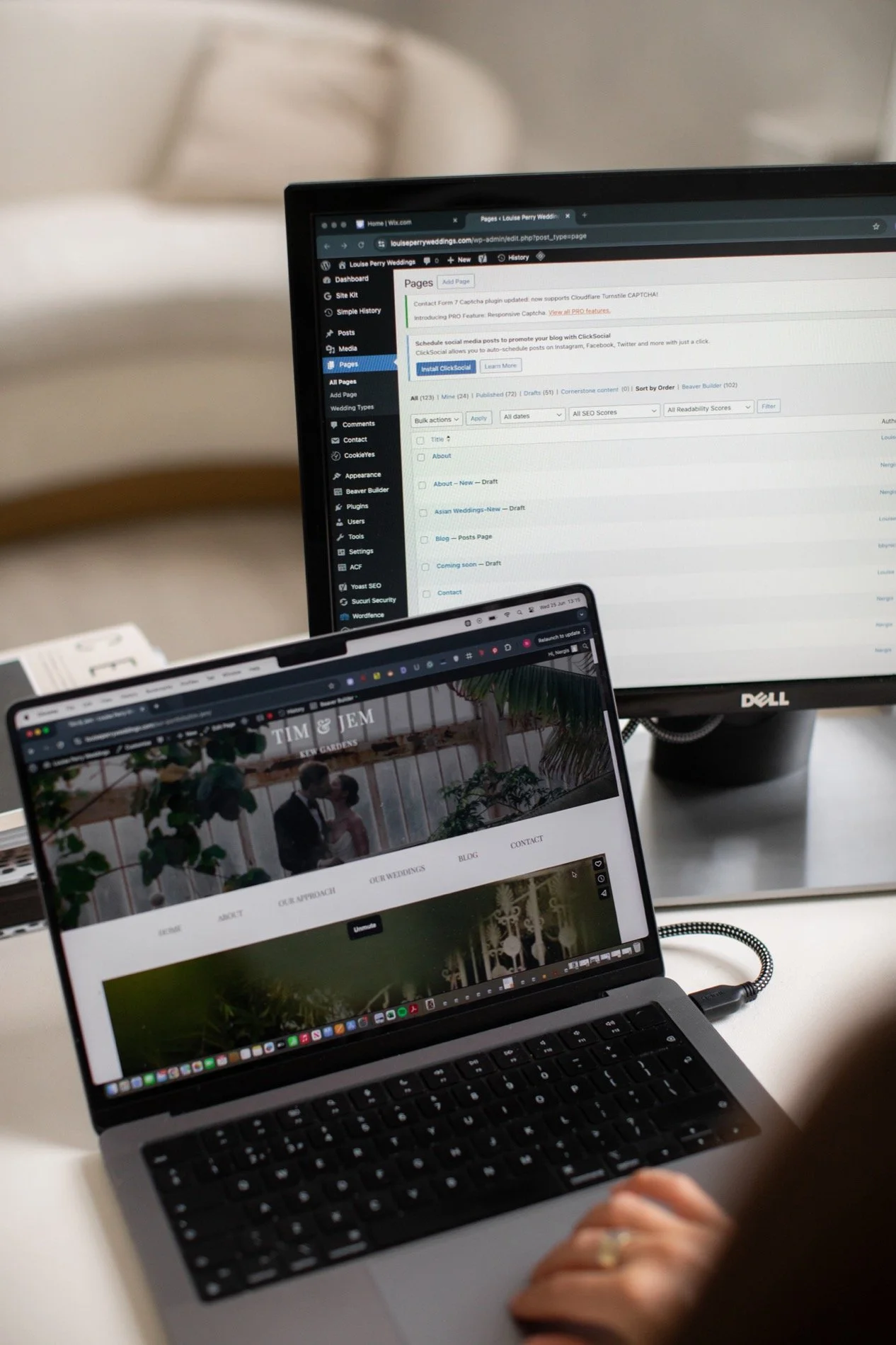
Portfolio pages are one of the most powerful and underutilised SEO tools available to wedding photographers. They’re not just a place to show off your beautiful images, they’re targeted landing pages that can rank for specific venue names, locations and styles.
Think about it: a couple who is getting married at Blenheim Palace and searching for ‘Blenheim Palace wedding’ is highly qualified. They know where they’re getting married, they know what they want, and if you have a portfolio page for that venue, you have a real chance of appearing in those search results.
When creating portfolio pages, always include the venue or location name in your page title, meta title, meta description and in the written content. Don’t just drop in a gallery with no text - search engines can’t read images, so the written content on the page is what tells them what the page is about.
I always recommend my wedding photography clients prioritise portfolio pages over blog posts. They take less time to create, they’re directly tied to real booking intent, and they convert browsers into enquiries much more effectively.
Pro Tip: Always tag yourself as the 'wedding photographer' on your portfolio pages, and link back to your homepage or about page. Couples who find a portfolio page through search may not know who you are yet - make it easy for them to learn more and get in touch.
Step 6: Build Backlinks and Improve Your Domain Authority
A backlink is a link from another website to yours. Every time a reputable website links to your site, it signals to Google that your content is valuable and trustworthy, which helps you rank higher for competitive keywords.
As a wedding photographer, you have a natural advantage here. Every vendor you work with - florists, venues, planners, caterers, stylists - has a website, and they all love beautiful photography. After a wedding, send a curated selection of your images to all the vendors involved and encourage them to feature your work on their websites, with a link back to yours.
You can also submit real weddings to wedding blogs and publications, contribute guest articles, or get featured in vendor spotlights. Each of these is an opportunity to earn a backlink while also building your profile in the industry.
Building domain authority is a gradual process - it won’t happen overnight. But over time, a growing backlink profile makes it progressively easier to rank for more competitive keywords and pull ahead of photographers who have similar content but fewer external links.
Pro tip: Two opportunities that are often overlooked but incredibly valuable right now are podcasts and Reddit. Being a guest on a wedding industry podcast typically earns you a backlink from the show notes, builds your authority as an expert, and gets your name in front of a relevant audience. Reddit is worth paying attention to too, as it’s increasingly being cited by AI search tools like ChatGPT and Google’s AI overviews, so contributing genuine, helpful answers in relevant subreddits and linking back to your website where appropriate can be a surprisingly effective way to build both authority and visibility.
Step 7. Create High-Quality Content for Your Ideal Couples (Optional but Valuable)
Let me be honest with you: blogging is optional for wedding photographers, especially if you’ve been in the industry for a while or are targeting higher-end clients. You can achieve excellent SEO results purely through well-optimised service pages, portfolio pages and a strong Google Business Profile. I’ve seen it happen many times.
That said, if you enjoy writing, are new to the industry or want to build an additional layer of visibility, blogging can be a great addition to your SEO strategy. The key is to write about things your ideal couples are actually searching for, not general wedding trends or tips that have nothing to do with booking a photographer.
Think about the questions couples ask you before they book. ‘How do I choose a wedding photographer?’ ‘Is a wedding photographer worth the cost?’ These are the kinds of blog posts that attract the right people to your website. And if you’re not sure what to write about, check out my blog post on ‘fail-proof wedding blog post ideas’.
Pro Tip: Always introduce yourself at the start of your blog posts and include a clear call to action at the end. Couples who find your content through search have never heard of you before - don’t assume they know who you are or what you offer. And guide them to the next step, whether it's exploring your services or browsing your portfolio pages.
Step 8: Optimise Your Pinterest for Search
Pinterest is not just a social media platform; it’s a visual search engine. And for wedding photographers, it’s one of the most powerful discovery tools available.

Couples (and wedding planners) spend hours on Pinterest in the early stages of wedding planning, searching for inspiration, styles and photographers. If your work is on there and it’s optimised correctly, you can show up in those searches and get in front of couples who are actively looking for someone like you.
The key difference between Pinterest and Instagram is that Pinterest content has a much longer lifespan. A well-optimised pin can drive traffic to your website for years after you post it. That makes it one of the most time-efficient SEO investments you can make.
Here’s how to make your Pinterest work harder for your SEO:
Optimise your profile. Your Pinterest display name and bio are searchable. Include your main keyword naturally.
Use keywords in your pin titles and descriptions. Think about what a couple would search for, go back to your keyword list and write your titles and descriptions accordingly. ‘Romantic autumn wedding at Kew Gardens’ is far more searchable than ‘C&A’s spectacular wedding’.
Create boards with keyword-rich names. Instead of ‘Wedding Photography’, create boards like ‘London Wedding Photography’, ‘Ohio Elopements’ or ‘Fine Art Wedding Photography’. These board names are indexed by Pinterest’s search algorithm and can even be shown in Google search results.
Link every pin back to your website. The whole point of Pinterest SEO is to drive traffic to your website. Every pin should link to the relevant page - a portfolio page, a blog post, or your contach page.
Be consistent. Pinterest rewards accounts that pin regularly. One fresh pin a day will build momentum over time.
Pro tip: Every blog post and portfolio page you create for your website should also become a pin on Pinterest. You’ve already done the work, now let Pinterest help amplify it and drive additional traffic back to your site.
Step 9: Make Your Instagram Searchable
Instagram has evolved significantly as a search platform. Couples are increasingly using Instagram’s search function to discover photographers, searching for keywords, locations and styles rather than just browsing their feed. This means that how you set up your profile and how you write your captions has a real impact on whether you show in those searches.
It’s worth being clear about something here though: Instagram SEO works differently from Google or Pinterest. It’s not going to replace your website SEO or drive the same volume of traffic. But it is an additional layer of discoverability, and for wedding photographers, whose ideal clients are very active on Instagram, it’s absolutely worth getting right.
I have a detailed, free guide on Instagram SEO, which will show you everything you need to optimise your profile. Make sure to grab your copy.
Pro tip: The couples who find you through Instagram search are often in the very early stages of planning. Think of your Instagram as the top of your funnel - it’s where discovery happens. Your website is where conversion happens. Make sure your bio includes direct links to your services, portfolio and contact page.
Step 10: Measure and Track Your SEO Performance
You can’t improve what you don’t measure. Once you’ve started working on your SEO, it’s important to check in on your results regularly - not every day (that way madness lies!) but once a month is a great habit to get into.
The only tool you need for your website SEO is Google Search Console. It’s free, it’s built by Google, and it shows you exactly how your website is performing in search results - which keywords you’re ranking for, which pages are performing best, and how many people are clicking through to your website.
If you haven’t set it up yet, my step-by-step guide to Google Search Console walks you through the whole process. And once you have data to look at, my guide on how to know if your SEO is working will show you exactly what to look for and how to interpret what you’re seeing.
For tracking traffic across all your other channels, make sure you have Google Analytics set up on your website. Your traffic acquisition report shows you which channels are sending visitors to your site and how that evolves over time. This is where you’ll start to see Pinterest, Instagram or AI-referred traffic showing up alongside your organic Google traffic, and it gives you a much clearer picture of which platforms are actually working for your business.
Pinterest also has its own built-in analytics, which is well worth checking in on regularly. It shows you which pins are getting the most impressions and outbound clicks, which boards are performing best, and what your audience is engaging with. This is really useful for understanding what’s resonating and what to create more of.
Bonus Tips to Take Your Wedding Photography SEO Further
Reduce Your Image File Sizes for a Faster Website
As a wedding photographer, images are the heart of your website - large, high-resolution images may look stunning, but image file sizes are one the biggest factors affecting your page speed. And we all know how frustrating slow websites can be, stopping users from exploring your site, leading to missed opportunities for bookings. It will also hurt your SEO.
Here’s the rule I follow with my clients: each individual image should be under 1MB, and the total size of all images on any single page should not exceed 20MB.
This keeps your pages loading quickly without noticeably compromising image quality.
The easiest way to do this is to resize your images directly on your laptop before uploading them. I usually resize to 1900 pixels wide - this is more than large enough for web display and dramatically reduces file size.
You can also use free tools like TinyPNG to compress them without any visible loss of quality.
Prioritise Your Image SEO
When search engines come to your website, they can’t see your images the way a human does. They read the text-based code behind them: the filename and the alt text. This means that how you name and describe your images has a direct impact on whether they show up in image search results.
For wedding photographers, appearing in Google image search can be a signifcant source of traffic. So optimising yours gives you an additional route to being discovered.
I have a detailed and to-the-point blog post on Image SEO Best Practices, where you can also find examples.
Ready to Take Your Wedding Photography SEO to the Next Level?
SEO is the long game, but it’s one of the most rewarding investments you can make in your business. The results build on themselves over time, and once your website starts ranking, it keeps working for you even when you’re not working.
If you’ve read this far, you already know more about SEO than most wedding photographers. Now it’s about taking action, one step at a time.
If you’d like personalised help with your SEO, here’s how I can support you:
SEO Services For Wedding Photographers

SEO Clarity Audit & Action Plan: Not sure where to start or whether your current SEO is working? I’ll personally review your website SEO, Google Business Profile, Pinterest and Instagram discoverability, and give you a recorded walkthrough of exactly what to fix and what to focus on. It’s the clearest, most actionable SEO feedback you’ll get, based entirely on your specific website and business.
Bespoke SEO Strategy & Coaching: If you’re ready for a professional to build a strong SEO strategy for your photography business, and want guidance and support as you implement it, this is for you. You’ll get a tailored keyword research, strategy and roadmap built around your business goals and your ideal clients - plus 1-1 coaching as you work through it.
Full SEO Makeover: Prefer to hand it all over and focus on your photography? With this done-for-you service, I’ll handle everything for you from research and strategy creation to implementation, saving you hours of work. With a holistic approach to your organic visibility, I’ll optimise your website, Google Business Profile, Instagram and Pinterest.
Whichever stage you’re at, there’s a way to get supported. Feel free to get in touch if you have any questions - I’m always happy to help and have a chat.

About the Author
I'm Nergis, an SEO consultant specialising in wedding businesses. I work with wedding photographers, videographers, and other wedding professionals to help them get found by the right couples across search. I take a holistic approach to SEO, looking at all the places your ideal clients are searching, not just your website.
Want to know a bit more about the person behind all this SEO talk? Head over to my about page.